What UPI Downtime During Peak Hours Actually Costs a Retailer?

What UPI Downtime During Peak Hours Actually Costs a Retailer?
By Charu Gupta Published: October 15th, 2026
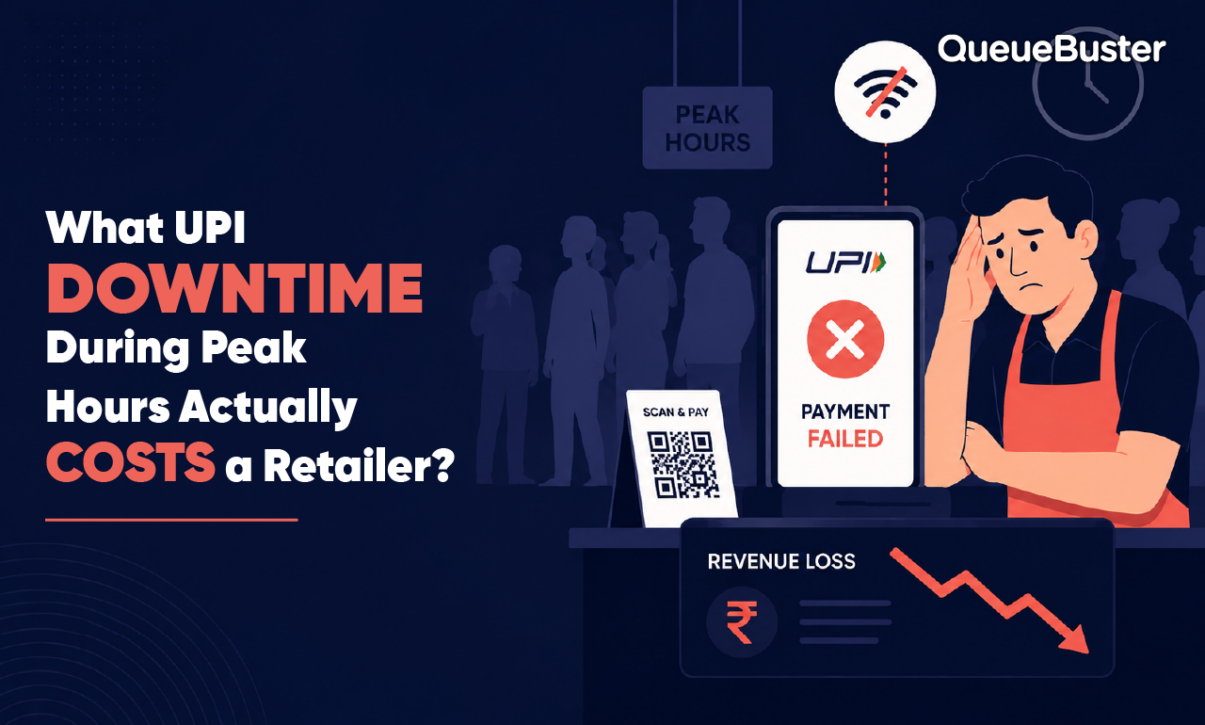
UPI has become the default payment method for a large share of Indian retail transactions, and for good reason, it’s fast, familiar, and doesn’t require carrying cash. But UPI’s dominance has also created a quiet dependency: when UPI infrastructure experiences downtime, which happens periodically at a national level, retailers whose billing software is built entirely around it are often left with no clear fallback, right at the exact moment customers are standing at the counter ready to pay.
Why This Isn’t a Rare Edge Case?
Nationwide UPI outages or degraded performance during high-traffic periods aren’t hypothetical, they occur periodically, often clustered around high-transaction-volume periods like festival sales or month-end shopping, precisely when a retailer can least afford payment friction at the billing counter. For a business that has, often without fully realizing it, made UPI the default and sometimes only smooth payment path in their POS software, a 20-30 minute outage during a peak Saturday afternoon isn’t a minor inconvenience, it’s a direct, immediate hit to sales.
What Actually Happens During an Outage?
- Transaction delays compound at the counter. Each failed or slow UPI attempt adds time to that transaction on the billing software, and the next customer in line waits longer too, turning a brief outage into a growing queue within minutes.
- Customers without cash walk away. Not every customer carries a meaningful amount of cash as backup; a UPI failure with no alternative payment option built into the POS software sometimes means a lost sale outright, not just a delayed one.
- Staff have no clear protocol. Without a defined fallback process built into the billing software workflow, staff often improvise inconsistently, some offer to hold items for a customer to pay later, others simply apologize and lose the sale, creating an inconsistent customer experience on top of the lost revenue.
- No system-level record of what was lost. Most billing software setups don’t specifically log “payment attempted and failed due to UPI downtime,” meaning retailers often have no clear data on how much revenue outages have actually cost them over time, it just shows up as a vaguely slower sales day.
Why Most Billing Software Setups Have No Real Fallback Plan?
The dependency happens gradually, card machines get used less as UPI becomes the default, cash handling gets deprioritized as digital payments dominate, and eventually the “backup” payment options within the POS software exist in name only, untested and unfamiliar to newer staff. By the time an outage hits, the fallback path is rusty at best.
What a More Resilient Payment Setup Looks Like?
- Multiple active payment rails built into the POS software, keeping card payment terminals genuinely functional and staff comfortable using them, not just present as a formality
- Clear staff protocol for outages, a simple, practiced process for what to do and say when UPI fails, rather than leaving it to improvisation under pressure
- Billing software that logs failed payment attempts, giving owners actual visibility into how often and how severely outages are affecting sales, rather than a vague sense that “today felt slow”
- Held-order functionality within the POS software, allowing staff to save a bill and let a customer complete payment once service is restored, rather than losing the sale entirely
Quantifying the Real Cost
For a retailer processing, say, 150 transactions on a typical Saturday with 70% via UPI, even a 15-minute outage during peak hours can meaningfully disrupt a significant share of that volume, some transactions delayed, some lost outright to customers who simply leave. Multiplied across the several outages that tend to occur over a year, the cumulative revenue impact is often larger than owners assume, precisely because it’s never been tracked as a distinct category of loss by the billing software itself.
The Takeaway
UPI’s reliability most of the time is exactly what makes its occasional downtime so costly, retailers have naturally, reasonably built their fastest checkout flow around it, without necessarily building an equally solid fallback for the moments it doesn’t work. POS software that treats payment resilience as a deliberate feature, multiple working payment rails, clear staff protocols, and visibility into failed transactions, turns an occasional outage from a lost-sales event into a minor, manageable hiccup, and that’s exactly the kind of resilience good billing software should be built to provide.
Popular Posts
What UPI Downtime During Peak Hours Actually Costs a Retailer?
UPI has become the default payment method for a large share of […]
Why Do Two Branches of the Same Store Never Have Matching Numbers?
Ask a franchise or multi-branch retail owner if their outlets follow the […]